Practical support with steel and timber piling, equipment selection and material handling, including specialist MOVAX operation.
Doberman Group Ltd supports contractors and plant businesses across the UK and Ireland with practical piling operation, equipment selection and project methods.
Excavator-mounted piling is part of a broader suite. Dedicated piling rigs, long-reach leader rigs, crane-suspended vibratory or impact equipment and hydraulic silent presses each have merits and drawbacks. Ground, pile design, access, programme and environmental limits determine the appropriate combination.
Compare the piling techniques, including standard, water-assisted, Super Crush and other press-in options.
Choose the support you need
- Operate the equipment: experienced operation, demonstration and site-based familiarisation.
- Improve the method: review sheet handling, machine positioning, attachment changes and the working sequence.
- Specify the plant: assess a complete piling tool carrier and the attachments that make it useful.
An excavator-mounted approach to steel sheets
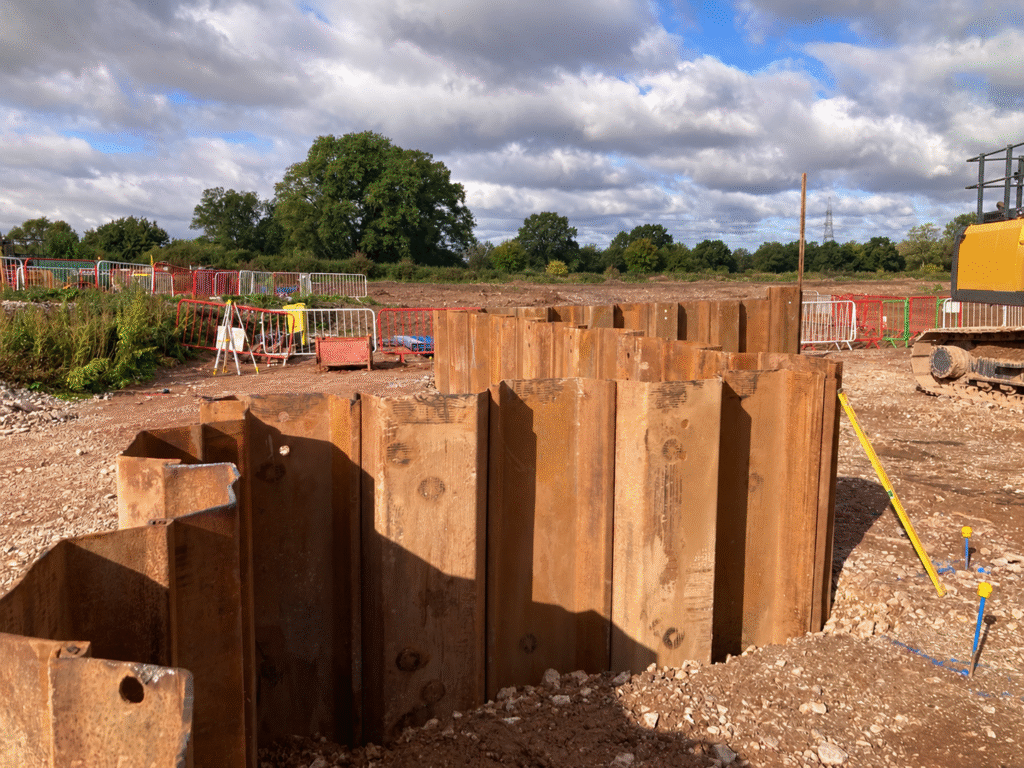
One excavator-based arrangement uses planned chain lifts to unload and move stacks of sheets (packs). A suitable MOVAX side grip then separates individual sheets, picks them up, positions them for driving, drives or extracts them, and stacks them. The project needs a competent lift plan, a suitable excavator and attachment, safe slinging access and a clear working method.
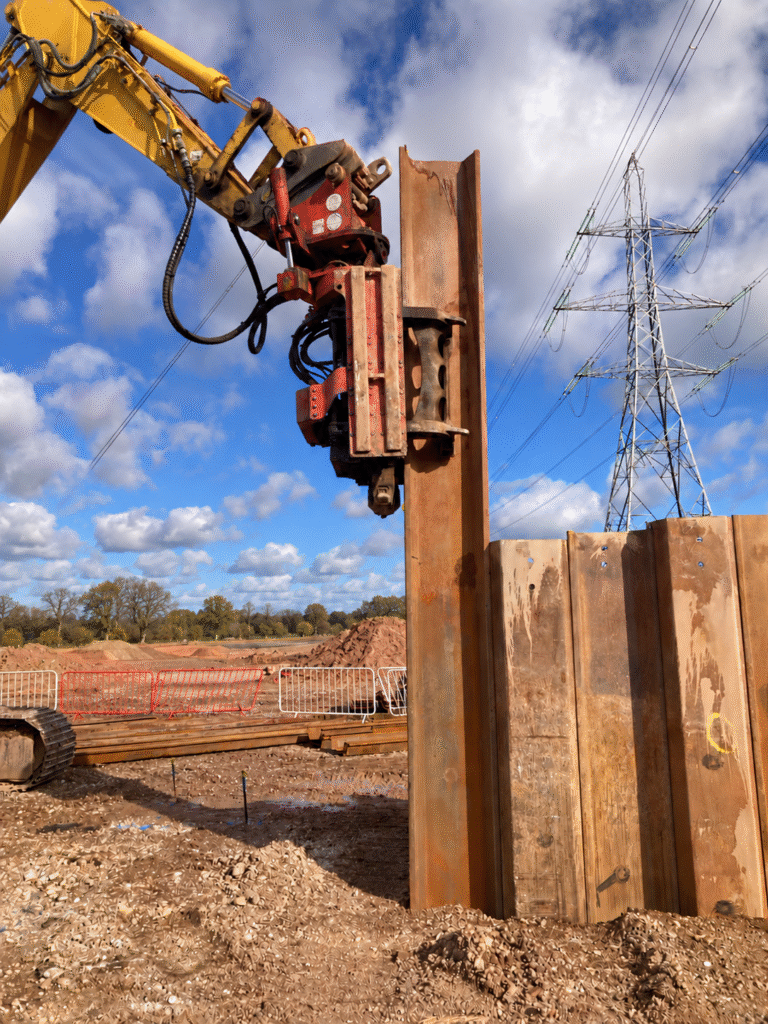
Lift planning considers the full hitch and attachment assembly, the actual distance of the load from the machine, single or paired sheets, ground support and lifting tackle. A reusable planning template is available where the client’s existing records need supplementing.
Doberman normally works under the client’s site arrangements and risk assessments and method statements (RAMS). We can review, supplement or rewrite the relevant method by agreement, with responsibilities and specialist design or lifting input identified before the work.
In suitable ground, the side grip alone can achieve the required pile depth. The wider attachment suite includes pre-augering (drilling ahead of pile installation) and impact back-driving (using a hammer to complete driving). These methods are used where the ground and pile design require them.
Doberman has received manufacturer training on MOVAX SG side-grip pile drivers, DH piling hammers and MPL multi-tool piling leaders.
A MOVAX can also handle and feed compatible sheets to a silent press, such as a GIKEN, under an approved coordinated method. Efficient feeding can keep the press working where noise or vibration constraints favour press-in installation. The handling role is separate from vibratory driving, which must remain within the site’s permitted method.
Read about MOVAX feeding a silent press.
GPS-guided sheet piling: compatible MOVAX and Trimble setups can help operators position sheets to a digital design model. Doberman can help assess compatibility and the practical workflow with your supplier and survey team. Availability depends on the specific equipment and control-system configuration.
Developing an excavator-based system
A piling attachment is only part of the system. A reduced tail, two-piece boom and approved blade arrangement can help a suitably specified excavator work closer to itself and manoeuvre on constrained sites. Better pack handling can remove delays before they reach the piling operation.
Our preferred development concept uses short, suitably spaced forks with a hydraulic grab bar to restrain each pack. A removable tiltrotator, which tilts and rotates the attached tool, may improve pack alignment. Connecting directly to the machine hitch may suit heavier packs or open layouts. Every arrangement needs verified capacity, ground support and reliable retention of the whole load.
Timber piling and access routes
Doberman can harvest standing timber, mechanically de-limb it, cut it to length and install timber piles. With the right equipment, the normal process can run without personnel on foot in the active work area, reducing manual handling and support-labour requirements while improving the overall production cycle.
Suitable standing softwood blocks can also supply timber for access routes and roads on very wet ground, including wetland and marine projects where the design and permissions allow. Locally sourced timber can offer a route to lower-carbon construction; the benefit depends on the material choice and the whole project, including effects on soils and water.
We also explore forestry machinery for remote piling logistics, including adapted forwarders carrying precast, steel or timber piles and reinforcement cages to turbine and pylon sites. The machine conversion, load support, restraint and route need to be engineered for the actual application.
Explore timber piling and access routes.
Explore the equipment options
Start with the method you have. Open the topics that matter to your job.
Sheet handling and restrained pack forks
Conventional wrapped/choked chain arrangements need a lift plan for the actual nested sheets, including secure retention, sling ratings, sharp edges, access and landing. They can be appropriate, but slinging and un-slinging add time and manual exposure.
Purpose-designed forks with a hydraulic grab bar can reduce routine slinging and lorry-bed access. The forks support the load; the grab restrains every sheet through the permitted movements. Hydraulic fork spacing alone is not pack retention. Plain forks are not our preferred solution for unrestrained sheet packs.
Mechanical handling reduces exposure; it does not eliminate crushing, falling-load or machine-interface risk. The operator and dedicated radio-linked banksman remain, with other roles where the work requires them. The banksman directs the operation from a safe position outside the danger zone.
Carrier specification and a removable tiltrotator
For a new piling tool-carrier project, Doberman’s preference is a non-hybrid machine near the 40-tonne class, with reduced tail, two-piece boom, suitable blade and an engineered hydraulic installation. Hitachi ZX375USLC-7, Kobelco SK380SRLC-7 and Volvo ECR355E are candidates for a supplier-led specification exercise, not approved interchangeable conversions.
The two-piece boom can bring the attachment and load closer. A blade may assist levelling and an approved support stance, but ground-bearing and working-platform requirements still apply. Actual counterweight, tail sweep, reach, geometry and load charts determine the result.
A removable tiltrotator offers handling flexibility. Confirm both tiltrotator-fitted and direct-to-hitch arrangements. Side-grip vibration, impact hammer loads or a heavy leader must not pass through a tiltrotator without approval for the exact duty.
Mechanical quick hitches and direct pin mounting
| Arrangement | Useful when |
|---|---|
| Compatible automatic system | Frequent changes or a varied tool suite justify the installation and conversion cost. |
| S-type hitch with manual services | A compact, verified mechanical interface is useful without fully automatic connections. |
| Other approved hitch, including pin-grabber | Existing attachment compatibility or conversion cost favours it. |
| Direct mechanical pins | Dedicated duty, low added mass or an equipment manufacturer’s requirement outweighs change flexibility. |
Tap an option to read the details.
Compatible automatic system
- Useful when
- Frequent changes or a varied tool suite justify the installation and conversion cost.
S-type hitch with manual services
- Useful when
- A compact, verified mechanical interface is useful without fully automatic connections.
Other approved hitch, including pin-grabber
- Useful when
- Existing attachment compatibility or conversion cost favours it.
Direct mechanical pins
- Useful when
- Dedicated duty, low added mass or an equipment manufacturer’s requirement outweighs change flexibility.
Mechanical S-type fit is different from Open-S automatic-service compatibility. Check exact models, size, locking, hydraulic/electrical services and the complete assembled rating. A hydraulically operated hitch does not necessarily connect the tool’s hoses.
Tall piling hammers can create unusual pickup or release angles. Use only the relevant manufacturer’s approved change procedure; do not improvise a safety-system bypass.
Hydraulic coupling choices
| Option | Doberman’s application guidance |
|---|---|
| Fully automatic connections | Optimum where duty and utilisation justify a compatible high-flow system. |
| Heavy-duty screw-to-connect couplings | Preferred manual solution; suitable flat faces and positive retention for vibration and pressure impulses. |
| Standard manual quick couplers | Consider only for side grips used infrequently or rarely disconnected, with suitability for the full operating duty verified. |
| Hoses threaded directly without separable couplings | Excluded from Doberman’s large side-grip method; maintenance access and controlled disconnection still matter. |
Tap an option to read the details.
Fully automatic connections
- Doberman’s application guidance
- Optimum where duty and utilisation justify a compatible high-flow system.
Heavy-duty screw-to-connect couplings
- Doberman’s application guidance
- Preferred manual solution; suitable flat faces and positive retention for vibration and pressure impulses.
Standard manual quick couplers
- Doberman’s application guidance
- Consider only for side grips used infrequently or rarely disconnected, with suitability for the full operating duty verified.
Hoses threaded directly without separable couplings
- Doberman’s application guidance
- Excluded from Doberman’s large side-grip method; maintenance access and controlled disconnection still matter.
Nominal 1 inch or 1¼ inch fittings do not establish adequate flow. Check the actual coupling, commissioned flow, pressure losses, return and separate case-drain limits, cooling and continuous duty. Direct hydraulic hose connections are a different issue from direct mechanical pin mounting.
Pre-augering, drilling rigs and impact back-driving
A hydraulically powered hanging auger, often called a dangle drill, is the usual simple excavator option for pre-augering. Doberman favours a suitable MOVAX leader-mounted auger where greater depth and more accurate guidance are needed.
For difficult or very hard ground and sustained production, consider a dedicated drilling rig such as a suitable GEAX where access and logistics justify it. An appropriately tooled MOVAX MPL may complete difficult drilling at a lower production rate; extremely hard material needs a ground-specific tooling and method assessment. Neither system guarantees penetration in every ground condition.
MOVAX DH hydraulic impact hammers and suitable alternatives such as BSP-TEX can back-drive piles after side-grip installation. The designer’s depth, set and refusal criteria control the work; refusal before the required acceptance is achieved means stop and review.
These are conditional options. Many projects need neither pre-augering nor back-driving. Where selected, drilling preparation and impact work require the relevant design, configuration and method controls.
Develop a complete tool carrier
Specify the carrier and handling method first, then compare ownership and hire of the required side grip, impact hammer, leader, drill or lifting jib. KTEG/Kiesel is our preferred first enquiry for the carrier concept; MOVAX and Watson & Hillhouse provide the relevant attachment information and potential hire discussions.
Supplier arrangements, installed cost and output depend on the actual proposal. Agree ratings, conversion responsibility, commissioning, maintenance, transport and demonstrations against representative loads. We can support early complex operation and help the client’s operator become familiar with the accepted configuration.
Read the piling equipment guide
Related support: operator development and MOVAX familiarisation, amphibious and waterside equipment, and plant and attachment innovation.
Discuss your piling project
Tell us the site location and the work you need to achieve. Include the pile type and dimensions, available ground information, access constraints, noise or vibration limits, and any equipment already selected. For sheet piles, add the profile, lengths and pack weights if known. We will help identify the practical next step.